




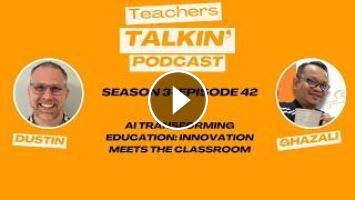
Dustin and Ghazali flip roles in this episode as Ghazali joins as the guest to talk about a question he’s been helping educators tackle around the world: How can we harness AI to enhance instruction while protecting the human connection that makes great teaching possible?
Drawing on two years of classroom work in Singapore, Ghazali shares concrete examples of AI’s real impact on students—from custom chatbots that helped his class prepare for high-stakes interviews and resumes, to a writing process where students plan and draft first, then use AI mind maps and feedback to refine their thinking instead of letting the tool do the work for them. Along the way, he surfaces a central idea: used well, AI can actually deepen relationships, because it frees time and creates more success moments for students.
They also unpack teacher-facing AI—tools that speed up planning, feedback, and resource creation—alongside the risks of over-reliance, security concerns, and students starting to “sound like ChatGPT.” Rather than mastering everything, Ghazali argues for a mindset shift: start small, learn one tool well, and let AI act as a multiplier while you stay firmly in charge of the pedagogy.
Interested in joining us on the podcast? We’re always looking for passionate educators and school leaders to share their insights—no need to be an “expert.” Tell us what you’d like to talk about here: https://forms.gle/RCeUFhmvLxY1nRwU9
Drawing on two years of classroom work in Singapore, Ghazali shares concrete examples of AI’s real impact on students—from custom chatbots that helped his class prepare for high-stakes interviews and resumes, to a writing process where students plan and draft first, then use AI mind maps and feedback to refine their thinking instead of letting the tool do the work for them. Along the way, he surfaces a central idea: used well, AI can actually deepen relationships, because it frees time and creates more success moments for students.
They also unpack teacher-facing AI—tools that speed up planning, feedback, and resource creation—alongside the risks of over-reliance, security concerns, and students starting to “sound like ChatGPT.” Rather than mastering everything, Ghazali argues for a mindset shift: start small, learn one tool well, and let AI act as a multiplier while you stay firmly in charge of the pedagogy.
Interested in joining us on the podcast? We’re always looking for passionate educators and school leaders to share their insights—no need to be an “expert.” Tell us what you’d like to talk about here: https://forms.gle/RCeUFhmvLxY1nRwU9
- Category
- Artificial Intelligence & Business
Post your comment
Up Next
Autoplay
-
09:09

How Artificial Intelligence is Transforming Education? Learn About Applications of AI Into Education
-
5:15:59
AI & Business Summit – Where Innovation Meets Influence
-
00:50
Artificial Intelligence is transforming the classroom experience ???? ????????????
-
01:52
Education adapts as Artificial Intelligence enters the classroom
-
01:24
Generative artificial intelligence, a once taboo subject in education, is now a classroom tool.
-
AI and the future of humanity | Yuval Noah Harari at the Frontiers Forum
-
13:10

Can AI really save the World? ft. Bill Gates
-
Asking Sophia, Hanson Robotic’s human-like AI robot, to show her range of emotions.
-
01:00
Man WRONGFULLY Arrested Using AI #shorts
-
00:20

Robot Attacks Factory Worker! #shorts
Comments